
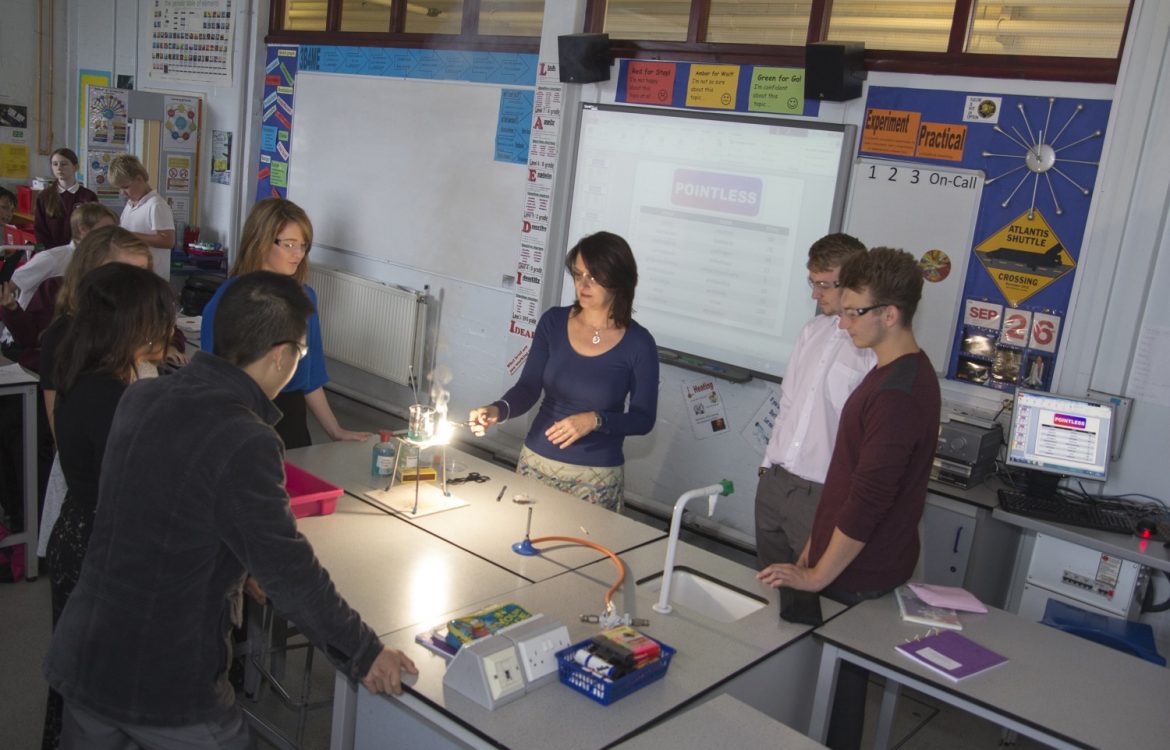
Chemistry
Aims of the course
- Develop a strong knowledge and understanding of the fundamental principles, concepts and processes of chemistry.
- Understand how chemistry contributes to society and addresses real-world issues, including energy, sustainability, medicine, materials and the environment.
- Develop competence and confidence in a wide range of practical, mathematical and problem-solving skills that are fundamental to chemistry.
- Learn how scientific methods are used to collect and interpret evidence, test hypotheses, evaluate data and draw justified conclusions.
- Develop critical thinking, analytical and communication skills through interpreting information, evaluating evidence and constructing scientific arguments.
- Understand the links between different areas of chemistry and apply knowledge to unfamiliar situations and real-world problems.
- Prepare for further study and careers in areas such as medicine, pharmacy, chemical engineering, biotechnology, environmental science and forensic science.
- Foster curiosity and enthusiasm for chemistry and an appreciation of its importance in the world around us.
Content
3.1 Inorganic chemistry
Students develop their understanding of the periodic table and how the electronic structure of atoms influences their chemical properties and reactions. Topics include periodicity, Group 2, Group 7 and the properties and reactions of elements and their compounds.
The course develops students’ ability to explain trends in chemical behaviour using atomic structure and bonding. Practical work provides opportunities to investigate chemical reactions and analyse substances using appropriate techniques.
In Y13 students investigate the characteristic properties, reactions and uses of transition metals, including complex ions, colours, ligand exchange and redox reactions. These concepts provide links to areas such as catalysis, materials science and industrial chemistry.
3.2 Organic chemistry
Organic chemistry introduces students to the structure, reactions and properties of carbon-based compounds. Students study a range of homologous series, including alkanes, alkenes, halogenoalkanes, alcohols, aldehydes, ketones, carboxylic acids and derivatives, as well as aromatic compounds.
Students develop an understanding of reaction mechanisms and learn how organic reactions can be used in the synthesis of useful products. The topic provides important foundations for further study in areas such as medicine, pharmaceuticals and chemical engineering.
In Y13 students go on to study Topics include optical isomerism, aldehydes and ketones, carboxylic acids and their derivatives, aromatic chemistry, amines, amino acids, polymers and organic synthesis. Students develop their understanding of reaction mechanisms and learn how analytical techniques can be used to identify and distinguish between organic compounds.
Analytical chemistry provides an important connection between theoretical chemistry and its practical applications in areas such as pharmaceuticals, environmental monitoring, forensic science and industry.
3.3 Physical chemistry
Physical chemistry develops students’ understanding of the mathematical and theoretical principles that underpin chemical behaviour.
Students study topics including atomic structure, amount of substance, bonding, energetics, kinetics, chemical equilibria, thermodynamics, rate equations and electrode potentials. They learn to use mathematical models and quantitative data to explain and predict chemical behaviour.
Practical skills
Practical work is an integral part of A-level Chemistry. Students develop their ability to safely plan and carry out experiments, record observations and measurements, process data, evaluate results and draw conclusions.
Students complete the required practical activities specified by AQA and develop the practical skills needed for the Practical Endorsement. Practical techniques include titration, preparation of compounds, qualitative tests, calorimetry, rates experiments and investigations involving organic and inorganic substances.
Throughout the course, students also develop their ability to apply practical knowledge to unfamiliar experimental situations and examination questions.
Curriculum map
| Year | Curriculum overview | Assessment |
| 12 | Atomic structure, Amount of substance, Bonding, Energetics, Kinetics, Chemical equilibria, Oxidation, reduction and redox, Periodicity, Group 2, Group 7, Introduction to organic chemistry, Alkanes, Halogenoalkanes, Alkenes, Alcohols, Organic analysis
|
|
| 13 | Thermodynamics, Rate equations, Equilibrium constants, Electrode potentials and electrochemical cells, Properties of Period 3 elements, Transition metals, further organic chemistry, Optical isomerism, Aldehydes and ketones, Carboxylic acids and derivatives, Aromatic chemistry, Amines |
|
| Career opportunities (What can this qualification lead to) |
| Medicine and Healthcare: Medicine, dentistry, veterinary science, pharmacy, biomedical science and clinical sciences.
Pharmaceuticals: Drug discovery, pharmaceutical development, formulation, quality control and research. Chemical Engineering: Development and manufacture of chemicals, fuels, materials, medicines and consumer products. Chemistry and Scientific Research: Analytical chemistry, organic chemistry, inorganic chemistry, physical chemistry and laboratory-based research. Environmental Science: Water quality, pollution monitoring, environmental analysis, sustainability and the development of cleaner technologies. Forensic Science: Analysis of chemical evidence, toxicology, DNA-related laboratory work and forensic investigation. Food and Consumer Industries: Food science, product development, quality assurance and chemical analysis. Energy and Materials: Renewable energy, battery technology, fuels, polymers and the development of new materials. Data and Technology: Chemistry develops quantitative and analytical skills that can be valuable in data-driven scientific and technological roles. Education and Communication: Chemistry teaching, scientific research, science communication and technical writing. |
Registration for : Chemistry
Error: Contact form not found.